6 Reasons Merchants Say Yes to Bank Card-Linked Offers
For merchants, bank offers programmes are a practical way to find new customers and fill quiet hours. Here are the six reasons they sign up, and stay.
A card-linked offers programme is a two-sided market. Banks bring cardholders; merchants bring the offers that make the programme worth opening. Without merchants who are genuinely enthusiastic, even the best-designed app will feel empty.
So why do merchants say yes? From small cafés to regional retail chains, the reasons tend to be practical. Here are the six we hear most often.
1. Access to a large, verified audience
A bank's cardholder base is one of the most valuable audiences in any market. These are real people with active cards, living and working in the area, who spend regularly.
For a merchant, that is very different from buying reach on social media, where many impressions go to people who are far away, not interested or not real at all. Every cardholder who sees a bank offer is a verified customer of a trusted institution.
Many merchants also value the association. Being featured by a well-known bank signals quality and stability to customers who have not visited before.
2. Paying for results, not attention
Traditional advertising asks merchants to pay upfront and hope. Card-linked offers typically work the other way round: the value of the offer is only given when a customer actually visits and redeems it.
For small businesses in particular, this changes the maths:
- No large upfront media budget.
- Cost linked directly to real customer visits.
- Easy to pause, adjust or end offers that do not work.
It is marketing that behaves more like a sales commission than an advertising bill.
3. Filling quiet hours and slow days
Almost every business has periods when staff, space and stock sit underused: weekday afternoons at a café, early evenings at a restaurant, mid-morning at a salon, the hot summer months for outdoor venues.
Card-linked offers can be scheduled precisely for those gaps. A merchant can offer a free dessert from Sunday to Wednesday or a discount between 2 and 5 pm, without discounting busy periods when customers would come anyway.
This makes offers a capacity management tool, not just a promotion.
4. Reaching the right customers, not all customers
Targeting is a major reason merchants join. Instead of broadcasting to everyone, the bank's platform can show an offer to cardholders who:
- Live or work nearby.
- Already spend in the merchant's category.
- Match the merchant's likely audience, such as families, young professionals or premium cardholders.
Merchants get more relevant visits, and cardholders see offers that make sense to them. Importantly, merchants do not need to receive personal customer data for this to work; the targeting happens inside the bank's environment.
5. Clear data on what is working
Many merchants struggle to measure marketing. They can see likes and views, but not visits and sales.
An offers programme gives them a simple dashboard:
- How many cardholders viewed the offer.
- How many redeemed it, and when.
- How many were new versus returning.
- Which days and times worked best.
With that visibility, merchants can refine offers quickly: shifting timings, adjusting the value or trying a new format. Merchants who can see results are far more likely to stay.
6. Simple to join and simple to run
Merchants are busy. Anything that requires long forms, new hardware or complex integration will struggle. The programmes merchants value most are the ones that fit into their day:
- Quick digital sign-up, with contracts signed electronically and confirmed by OTP.
- Offer templates that make creating a good offer a few taps.
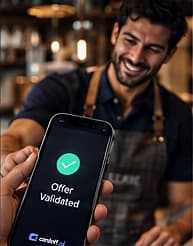
- Easy validation, such as entering a customer's rotating code, a QR tent card at the counter or a coupon code for online orders.
- Arabic and English across every tool, so owners and staff are comfortable.
- Support when needed, through live chat or tickets.
When joining takes minutes rather than weeks, merchants are much more willing to try.
A bonus reason: one set-up, many banks
Where a platform runs a shared merchant network, a merchant can extend offers to cardholders of several banks at once, with one sign-up and one set of tools. That multiplies reach without multiplying effort, which is especially attractive for smaller businesses.
What merchants worry about, and how to address it
Merchants also have reasonable concerns. Addressing them openly builds trust:
- "Will I lose money on discounts?" Help them design offers that target new customers and quiet times, with sensible limits.
- "Will my staff understand it?" Provide short training, printed tent cards and simple validation.
- "Will I see card data?" Explain that they will not; redemption uses codes, not card numbers.
- "What if it does not work?" Make offers easy to pause and review results with them after the first month.
The bottom line
Merchants join bank offers programmes because they bring verified, relevant customers at a cost linked to results, with clear data and minimal effort. Banks that make the merchant experience as good as the cardholder experience build networks that grow.
cardoff.ai gives merchants a fast digital sign-up, e-signed contracts, a simple validation app, clear dashboards and access to cardholders across multiple banks through a shared network. If you are a merchant in the GCC, or a bank building a merchant network, we would be glad to show you how it works.