This is an illustrative story. The studio, its founders and the numbers are hypothetical, but the challenges are common to many wellness businesses across the Gulf.
Noor and Sara opened a small fitness studio in Riffa two years ago. They offered strength classes, pilates and a women-only morning session that quickly became popular. The instructors were excellent, the reviews were warm and the members who joined tended to stay.
The problem was getting people through the door in the first place.
The acquisition treadmill
Like many wellness businesses, the studio relied on social media. Noor posted workout videos, Sara ran giveaways, and they paid for ads during January and before summer. Followers grew steadily. Memberships did not.
When they looked closely, the pattern was clear:
- Many followers lived far away or were outside Bahrain entirely.
- Free trial class sign-ups often did not show up.
- Paid ads were expensive during peak seasons, when every gym was advertising.
- It was hard to tell which posts or ads had actually produced a paying member.
They were spending time and money on attention, not on members.
A different channel
A local bank invited the studio to join its card-linked offers programme. The idea appealed to Sara, who handled the finances: the studio would create an offer for the bank's cardholders, the bank would show it to people likely to be interested and the studio would only give away value when someone actually came in.
Onboarding took one afternoon. Noor signed the merchant agreement digitally on her phone, confirmed with a one-time password and created two offers:
- "First class free, plus 20% off your first month if you join within seven days."
- "Bring a friend to any weekend class for free."
The first offer targeted new members. The second aimed to use existing members as ambassadors.
Who saw the offers
The bank's offers app did not show the studio to every cardholder. Targeting focused on people for whom it made sense:
- Cardholders living or working within a reasonable drive of Riffa.
- People who already spent in wellness categories, such as sportswear, health food and other fitness venues.
- Customers who had recently shown interest in similar offers.
The women-only morning session was highlighted in the offer description in both Arabic and English, which turned out to matter a great deal.
How redemption worked
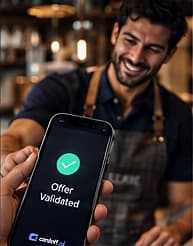
When a new customer arrived for a free class, they opened the bank's app and showed a rotating code. The receptionist entered it in the merchant validation app. When customers later joined with the 20% discount, the studio validated the second part of the offer the same way.
For the "bring a friend" weekend offer, the studio put a QR tent card on the reception desk. The member scanned it, confirmed in the app and their friend was checked in.
No card numbers were involved. The studio did not need new hardware; the validation app ran on the tablet they already used for bookings.
What changed
In this hypothetical example, over the first three months:
- Trial class attendance was far more reliable than with social media sign-ups, because offer users had already chosen a time and were nearby.
- A healthy share of trial users joined within seven days to secure the first-month discount.
- The women-only morning session filled up and gained a waiting list, so the studio added a second morning slot.
- Weekend "bring a friend" visits brought in friends and family who often went on to try a trial class themselves.
The founders also noticed something unexpected: many new members were people who had lived nearby for years but had never heard of the studio.
What the dashboard showed
Every week, Sara checked the merchant dashboard. She could see:
- How many cardholders had viewed each offer.
- How many had redeemed the free class.
- How many had then redeemed the first-month discount, which was effectively a conversion rate.
- Which days and times worked best.
That clarity changed how they spent their marketing budget. They reduced paid social ads outside peak seasons and put more effort into the offers that were demonstrably producing members.
Why it worked
The offer matched the decision
Joining a gym is a considered purchase. A free first class lowers the risk; a time-limited joining discount encourages a decision while motivation is high.
The audience was already interested
Targeting by location and wellness spending meant the studio was reaching people who were likely to care, not just people who might like a video.
The cost was tied to results
The studio gave value only to people who walked in. There was no cost for impressions that went nowhere.
What the bank gained
For the bank, wellness offers are valuable because they build habits. A member who visits three times a week, buys a smoothie after class and uses the same card for sportswear is a highly engaged cardholder. The bank also built a relationship with a growing small business.
The takeaway for wellness businesses
If your business depends on people trying you once and then committing, card-linked offers can be an efficient way to find the right first-timers. Pair a low-risk first visit with a clear reason to join, target people nearby and let the data guide what you do next.
cardoff.ai helps gyms, studios, spas and clinics reach banks' cardholders with offers that are easy to create, sign digitally and validate in seconds. If you run a wellness business in the GCC, we would be happy to show you how to get started.